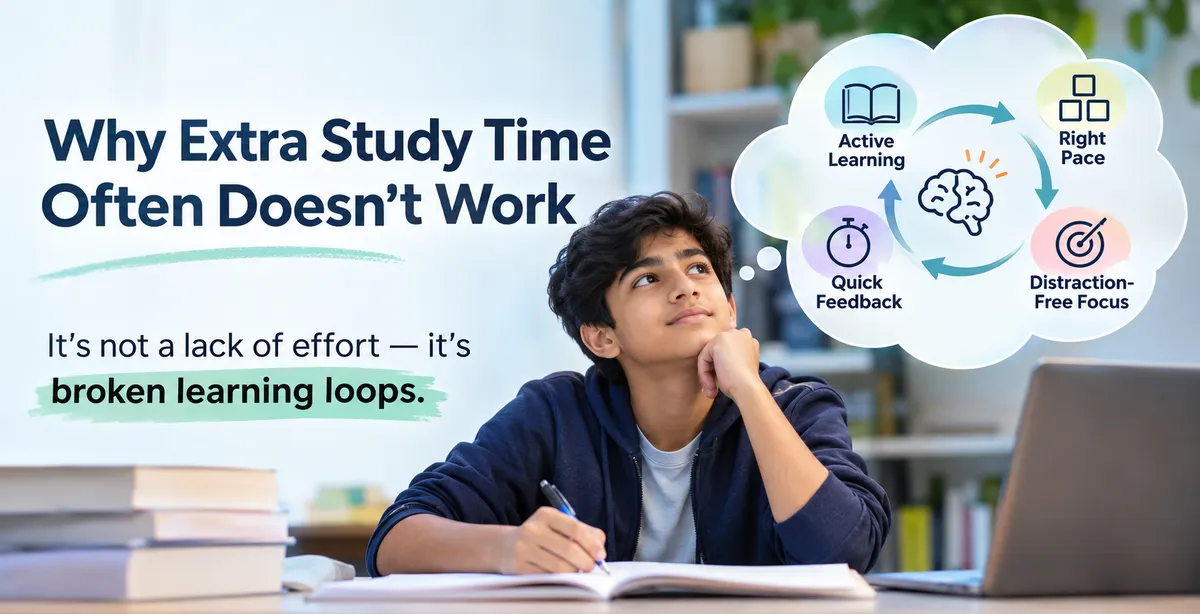
Why Capable Students Still Struggle in School—And How Better Systems Can Help
- Team SaNiSa
- Learning , EdTech
- 15 Feb, 2026
When a student struggles with a subject in school, the default reaction is usually to ask them to put in more hours.
Parents schedule extra study time. Teachers assign additional worksheets. Students sit at their desks longer, re-reading textbooks or watching explanation videos late into the evening. Yet, when the next test arrives, the results often barely move.
When you observe how students actually study—both in classrooms and at home—a clear pattern emerges:
Most academic struggles are not caused by a lack of effort.
They are caused by broken learning loops—small, everyday friction points in how students absorb, practise, and get feedback on what they learn.
Let us look at four of the most common challenges students face in school today, and how thoughtfully engineered systems can remove them.
1. The “Illusion of Competence” (Passive vs. Active Study)
Ask a student how they revise for an exam, and most will say: “I read the chapter twice and watched a video on it.”
While reading notes or watching a polished teacher explain a concept on screen, everything makes sense. The steps look logical, so the brain assumes it has mastered the topic. Cognitive scientists call this the illusion of competence—confusing recognising an answer with being able to produce it from scratch.
The real test happens when the textbook is closed and a blank sheet of paper is in front of the student. Without active recall—forcing the brain to retrieve, explain, and apply the concept independently—information fades within days.
2. The “One-Pace” Classroom Gap
School calendars have to move forward at a fixed speed. Whether a class has 25 students or 45, the syllabus must be completed on schedule.
In subjects like mathematics, science, and computing, concepts stack on top of each other like building blocks:
- If a student misses a small foundational idea in Chapter 2, Chapter 5 suddenly feels overwhelming.
- On the flip side, if a student has already mastered a concept, sitting through repetitive basic drills causes boredom and disengagement.
Without a way to spot and repair individual concept gaps early, small misunderstandings quietly snowball over an entire academic year.
3. Delayed Feedback Loops
Think about how a student learns to ride a bicycle or debug a piece of code: when they make a mistake, they see the result immediately and adjust on the next try.
In traditional school workflows, feedback is often delayed by days or weeks. A student writes a descriptive answer on Monday, submits the notebook on Tuesday, and receives the corrected copy the following week. By the time the feedback arrives:
- The student has forgotten their original train of thought.
- The class has already moved on to a new chapter.
- The grade is treated as a final verdict rather than a chance to improve.
This is not the teacher’s fault—manually grading hundreds of descriptive answers takes enormous time and energy.
4. Studying on Distraction Machines
Today, homework and revision almost always require a screen. Unfortunately, the same tablet, laptop, or phone that hosts study material is also engineered to interrupt the student every few minutes.
Even a 30-second context switch—glancing at a message or clicking a recommended video—breaks working memory. A two-hour study session fragmented by constant micro-interruptions leaves the student exhausted, with very little deep comprehension to show for the time spent.
Building Systems Around How Students Actually Learn
At SaNiSa Solutions, we look at these four bottlenecks not as student failings, but as system design problems. Every product in our ecosystem is built to close one of these specific gaps:
Turning passive study into active mastery with LearnYet and FocusYou
Instead of measuring how many videos a student has watched, LearnYet organises courses, worksheets, and checkpoints around verifiable understanding.
Alongside it, FocusYou protects the study environment itself. It replaces open-ended, distraction-heavy browsing with structured, time-boxed study sessions that weave active recall and short reflection prompts directly into the workflow—ensuring the brain is actively working, not just passively scrolling.
Fixing the “one-pace” gap with AquaLearn
AquaLearn tackles the classroom pacing problem through adaptive learning. Rather than serving the exact same sequence of questions to every student, it evaluates current understanding, pinpoints the exact prerequisite gap holding a learner back, and adjusts question difficulty in real time. Struggling students get targeted scaffolding where they need it, while advanced learners are challenged to go deeper.
Closing the feedback loop with AssessQ&A and MentorDesk
To make feedback fast and actionable, we have to support the teacher as much as the student.
AssessQ&A handles the heavy lifting of first-pass evaluation on written answers, giving students rapid, structured feedback while freeing teachers to focus on nuanced guidance. Meanwhile, MentorDesk streamlines lesson planning and targeted activity creation so educators can spend less time on administrative paperwork and more time mentoring students one-on-one.
A Better Question to Ask
When a student feels stuck, the answer is rarely “just study harder.”
Instead, it helps to ask four simple questions about their environment:
- Are they actively recalling concepts, or just passively re-reading?
- Is their practice material adapting to their specific gaps?
- Are they getting timely feedback while the topic is still fresh?
- Is their study tool protecting their focus?
When you fix the system around the learner, effort finally translates into confidence, clarity, and real-world skill.


